





Specialist Tools


Fits
Boxster/Cayman 1997-2008
Porsche 911 Carrera 1999-2008 (Excludes Turbo, GT3 and GT2 models)
Description of Tool
This is a 3D Printed tool for installing the Rear Main Seal on Porsche M96/M97 engines to the correct depth without damage to the seal. The tool is 3D printed from hard, black plastic and is very solid and durable. It is aimed at DIYers and hobbyists due to its low cost in comparison to the official Porsche tool, but would be well suited to small independent garages as the tool can be reused many times without damage.
How to use
Care must be taken when using this tool as although it is designed to make the installation of the seal as easy as possible, it is still possible to damage or incorrectly install the seal if care is not taken to install the seal properly. We accept no responsibility for incorrect usage of the tool and possible damage to the seal or engine of the vehicle. We advise you to always confirm with a digital calipers or other measuring device to make sure the seal is installed at the correct depth.
To use this tool you will also need 4 M10 X 75mm bolts and 4 washers. This is to allow for the extra thickness of the tool, and to spread the force from the bolts across the surface of the tool.
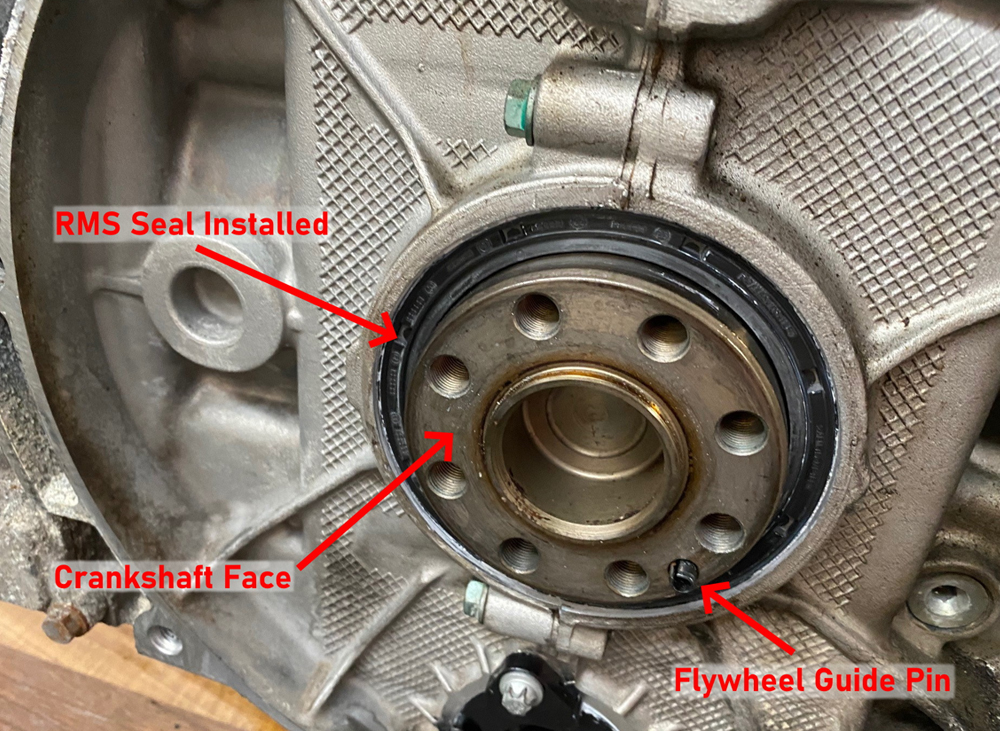
The seal must first be correctly orientated and then gently located into the opening around the crankshaft. To do this, leave the blue plastic ring in place and place the seal over the end of the crankshaft. Then push the seal on gently so that the end of the crankshaft pushes the blue ring out of the seal and the seal gets pushed onto the outside of the crankshaft.
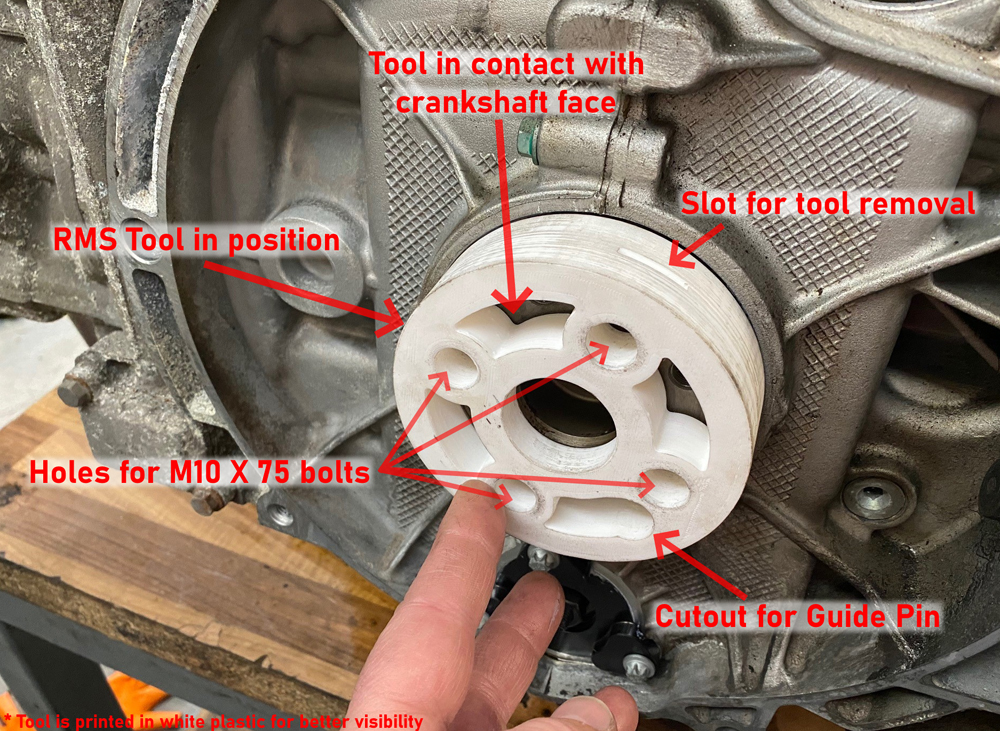
Next place the RMS fitting tool over the seal and thread each of the 4 bolts into the crankshaft, through the holes in the tool. Make sure to orientate the tool so that the cut-out for the flywheel guide pin in the crankshaft lines up with the pin. Screw each bolt in slowly until they just about make contact with the face of the tool. From this point on the seal will start to be inserted into the engine.
Turn each bolt a quarter turn at a time, turning all 4 a quarter turn before tightening the first one again, and continuing the cycle. It is very important that the bolts are tightened small amounts, one at a time to make sure that the seal is inserted straight and not at an angle which will damage the seal.
Repeat this until the face of the crankshaft comes into contact with the inner face of the tool and it will not push the seal in any further. Remember that the tool is plastic so excessive force at the point will possibly damage the tool and push the seal in too far.
The 4 bolts can now be unscrewed and fully removed from the crankshaft. The tool can then be removed. It may be a slightly tight fit, and if it is difficult to remove by hand then there are slots in the sides of the tool to allow a screwdriver or prying tool to grip the tool and remove it. If using the slots, be careful to apply even force to both sides to ensure that the tool does not come out at an angle and get stuck or potentially move the seal.
Once the tool and bolts are removed, visually inspect the seal to make sure there is no damage. Then, use a ruler, digital callipers or depth gauge, check the depth of the seal. It should measure 13mm, from the face of the crankshaft to the face of the seal. As long as the tool was used correctly and is suitable for your engine, the seal will be installed at the right depth.
These instructions are only intended as a rough guide, you should always check a workshop manual or research online to ensure the part is being installed correctly. Using this tool requires some practical knowledge so if you are not confident in your abilities please do not attempt to install the seal yourself.
Related reference numbers
Related, superseded, cross reference or alternative numbers for comparison.
0PB105249
The product you are viewing cross references to these numbers
- Porsche Boxster 986 2.5L 1997-99
- Porsche Boxster 986 2.7L 1999-02
- Porsche Boxster S 986 3.2L 1999-02
- Porsche Boxster 986 2.7L 2003-04
- Porsche Boxster S 986 3.2L 2003-04
- Porsche Boxster 987 2.7L 2005 -08/08
- Porsche Boxster 987 S 3.2/3.4L 2005-08/08
- Porsche 996 C2 3.4L 1997-08/01
- Porsche 996 C4 3.4L 1997-08/01
- Porsche 996 C2 3.6L 09/01-2005
- Porsche 996 C4 3.6L 09/01-2005
- Porsche 996 C4S 3.6L 09/01-2005
- Porsche 997 MK1 Carrera 2 3.6L 2005-08
- Porsche 997 MK1 Carrera 2S 3.8L 2005-08
- Porsche 997 MK1 Carrera 4 3.6L 2005-08
- Porsche 997 MK1 Carrera 4S 3.8L 2005-08
- Porsche Cayman 2.7L 987C 2006-08
- Porsche Cayman S 3.4L 987C 2005-08
 Shop Securely
 12 Month Warranty
 Worldwide Delivery



Specialist Tools for Accurate, Efficient & High-Quality Porsche Engine Rebuilds
Engine rebuilds require precise measurements, correct assembly procedures and the right equipment to ensure every component fits and functions exactly as intended. Specialist tools are essential when working on Porsche engines due to their unique engineering, tight tolerances and model-specific service procedures. These tools enable technicians and enthusiasts to dismantle, inspect, rebuild and calibrate engines with professional accuracy—reducing the risk of damage, misalignment or incorrect installation.
Whether performing a full engine restoration, carrying out timing work, inspecting internal components or installing performance parts, using the correct specialist tools guarantees a reliable, long-lasting and high-quality rebuild.
What Specialist Engine Rebuild Tools Do
High-quality specialist tools ensure precision and safety
throughout the rebuild process. They are designed to:
- Accurately
measure critical tolerances, including bore, deck height, ring gap and
valve clearances
- Correctly
install and remove components such as crankshafts, pistons, liners and
bearings
- Support
timing procedures, including camshaft alignment and intermediate shaft
setup
- Prevent
damage to delicate components during disassembly and assembly
- Improve
rebuild efficiency with purpose-built fixtures and holding tools
- Ensure
even torque application, promoting proper sealing and component
longevity
- Assist in diagnostic tasks such as leak-down testing or compression verification
Specialist tools are essential for achieving a professional-grade engine build with reliable and repeatable results.
Why Workshop Tools Wear or Fail
Even well-engineered tools degrade over time due to heavy
use, improper handling or exposure to harsh environments. Common causes of
failure include:
- Metal
fatigue from repeated loading
- Worn
or stripped threads on pullers, press tools or torque tools
- Corrosion
from moisture or chemical exposure
- Heat
damage from working near exhaust or cylinder heads
- Loss
of calibration, particularly with measuring or torque-sensitive tools
- Damaged
contact points from misuse or excessive force
- Contamination from debris or workshop dirt
A failing tool can cause inaccurate measurements, unsafe working conditions or even costly engine damage.
Why Specialist Tools Should Be Replaced or Upgraded
Replacing worn tools or upgrading to precision-engineered
alternatives provides clear benefits:
- Improved
measurement accuracy for critical engine dimensions
- More
reliable component installation, reducing the risk of misalignment
- Safer
workshop practices, preventing injury or engine damage
- Consistent
torque and calibration, essential for sealing and bearing load
- Enhanced
efficiency, saving time during complex rebuild procedures
- Better
compatibility with modern engines and performance upgrades
- Higher quality rebuild outcomes, improving engine reliability and longevity
Using proper tools is an investment in the quality of the rebuild and the health of the engine.
-
 Intermediate shaft (IMS)
-
Oil System Parts
-
Fuel System Parts
-
Gaskets & Sets
-
Radial Seal / RMS / Camshaft / Balance shaft
-
Belts / Tensioners / Rollers
-
Chains & Tensioners
-
Timing covers and gaskets
-
Engine Bearings / Shells
-
Engine Valves / Guides / Springs
-
Rocker Arms & Tappets
-
Engine Bolts / Studs
-
Engine Mounts
-
Piston Rings
-
Engine Cylinders / Liners / Pistons
-
Connecting Rod
-
Cylinder Head / Camshaft Carrier
-
Camshaft covers / Gaskets
-
Camshafts
-
Camshaft gears / sprockets and fixings
-
Crankcase Parts
-
Crankshaft & Parts
-
Air Intake & Injection
-
Vacuum Pump
-
Cylinder Liner